
West Virginia Deed Records and Instruments
Deeds in West Virginia are local records. The county clerk of the county commission records each deed and related writings for land in that county. Portal menus differ. One clerk's document-type list rarely matches another's exactly. The record groups below are common in West Virginia land-record systems, not a promise of identical dropdown names, so read both the instrument and its later index entries before concluding anything about the parcel.
| Deed or record type | What the record does | Common research use |
|---|---|---|
| Deed of conveyance | Records parties, instrument date, acknowledgment, consideration, acreage, legal description, and transfer language when shown. | Locate a recorded transfer and the land it describes. |
| Transfer-on-death deed | A deed record identified in the county land-record set; related beneficiary or later estate documents may continue the trail. | Check a death-transfer path alongside county and court records. |
| Trustee, commissioner, or officer deed | Records a conveyance signed by a trustee, special commissioner, or other officer. | Search both the signing officer and the former owner named in the statutory index. |
| Tax-sale deed or deed to purchaser | Records a deed associated with the delinquent-land or tax-sale process. | Cross-check the county clerk with sheriff and State Auditor records. |
| Deed of trust or mortgage | Records a secured interest; it is not by itself a deed transferring ownership. | Search for the original instrument and a later release or satisfaction. |
| Release, easement, lease, contract, or plat | Adds a later instrument or land reference to the county's indexed record set. | Read the related document when the question concerns access, terms, or subdivision context. |
A deed record shows what was filed and indexed. A deed book entry can carry a lot. Parties, instrument date, acknowledgment, consideration, acreage, and the legal description may all appear, along with granting language, reservations, liens, and the recording date. A deed of trust, release, lien, or easement may sit beside it in the same county land-record system. Each answers a different question.
County Clerks Keep West Virginia Deeds
West Virginia has no state recorder for deeds. Each county clerk of the county commission records and indexes the writings that affect land in that county. The list is long: conveyances, deeds of trust, mortgages, releases, liens, leases, contracts, easements, and plats. The county always comes first. A mailing city or ZIP label does not move a parcel's land record to a different clerk.
The West Virginia County Clerk Directory lists the courthouse office and contact details for each county. Clerks point to different systems. Some link to the Cott WV County Clerk Portal, others to RECORDhub or a local index. Paper books stay at the courthouse. Staff can search older entries at the counter. The assessor's land book helps you find the parcel and owner of record, but the clerk's record verifies the instrument.
Deed records remain in county custody. The state offers common assessment, mapping, and archives resources. None of them replaces the clerk. A county's portal may connect to the clerk's own recording system or online index books, so a statewide search can start an inquiry but cannot promise every image, year, or cutoff.
Fields in the WV County Clerk Portal
The WV County Clerk Portal is the legacy landing page for county land-record searches. It now points to RECORDhub for counties moved to the new service, though exact search labels differ by county. Guest access is limited. Paid images need an account.
| Field or control | Type | Required | Options or notes |
|---|---|---|---|
| County selection | Dropdown or link | Yes for a county query | Participating counties only; check that county's certified dates first. |
| Account user ID | Text | For subscriber login | Separate from a guest index search. |
| Password | Password field | For account login | The landing page notes that it is case-sensitive. |
| Create an Account | Link or form | For paid access | Accept terms, choose a subscription, and follow the current payment route. |
| Name or party search | Search field | County-dependent | May search grantor, grantee, or party; exact labels vary. |
| Document type | Dropdown or filter | County-dependent | Use the selected county's list for conveyances, liens, releases, plats, wills, or other offered types. |
| Date and certified dates | Date field or coverage page | Optional query; essential coverage check | Confirm the selected county's online starting point. |
| Document or image result | Link | Often paid or subscriber-only | Printing, download, image, watermark, and transaction charges vary. |
| Search, reset, or browse | Button or link | As shown by county | Available controls differ across live county pages. |
Decide what you need first. A name and document-type search can identify a likely filing in the index. The image is different. It lets you inspect the legal description and terms, so do not assume a free index row means a free image or that every record type is online.
West Virginia Online Deed Dates Vary
There is no single statewide online cutoff for land instruments. Dates vary by county. The Cott portal posts a county certified-dates page for participating systems. Check your county's date first. Then ask the clerk whether earlier books can be searched in person or by request. Continuous portal access does not mean every paper book or image is online.
Counties differ in guest access, subscriptions, image fees, and document types. The legacy price table gives a sense of the cost. It listed a 24-hour access option at $7.50 and a 30-day option at $35. Images ran $1.50 for the first two pages. Each added page cost $1. Printing or downloading through the PayPal flow carried a 5% service fee. RECORDhub transition notices point purchases to credit card instead.
Those are published examples only. They are not a universal county charge, so confirm current terms before paying. The clerk's counter is a separate route. Ask what plain or certified copies cost. Ask whether staff can search the older grantor and grantee books. Ask how mail requests work.
| Guest index | May expose searchable party and document data at no charge, depending on the county. |
|---|---|
| Subscriber or image access | May require an account, subscription, per-image fee, or transaction charge. |
| County clerk counter | Can search older books and provide plain or certified copies under the current schedule. |
| Archives and microfilm | Can extend a search into historical county books and indexes where holdings exist. |
Trace a West Virginia Grantor-Grantee Chain
A grantor conveys the interest. A grantee receives it. West Virginia Code §39-2-2 describes the county general index and its grantor and grantee entries. When a trustee, special commissioner, or officer makes the conveyance, the statute calls for indexing the former owner alongside the executing person. That is reason enough to search both names.
- Start with the parcel ID, current assessment owner, or known legal description. Open the latest deed entry in the correct county clerk index.
- Write down the grantor, grantee, recording date, document type, book/page or instrument number, and legal description.
- Search the grantor side for the deed by which that person received the same parcel. Compare lot, block, acreage, district, and map references.
- Repeat from each prior grantor. Search an officer, trustee, sheriff, executor, administrator, or commissioner as well as the former owner when that kind of deed appears.
- When the chain reaches a will, estate, partition, divorce, foreclosure, tax sale, or transfer-on-death record, check the related county or circuit clerk file.
- Grantor and grantee
- The parties indexed as conveying and receiving an interest.
- Chain of title
- The linked sequence of recorded instruments for the same land.
- Book and page
- A volume-and-page reference used in deed books, especially older records.
- Instrument number
- A reference assigned to a recorded document in a county system; keep it with any book/page citation.
Addresses alone are weak historical keys. Roads get renamed. Rural addressing can change, and an older deed may cite acreage or an old lot description instead of a modern street number. Parcel fields are not always available either. Before linking two entries, compare the legal description, plat, book and page, acreage, and adjacent owners.
Note: Search both party sides when an officer signs, because the former owner may be indexed alongside the signer.
West Virginia Deed Books Before Portals
Older West Virginia deed records live in a patchwork. The State Archives finding aid lists possible county holdings. Deed books, grantor-grantee indexes, trust deed books, surveyor books, land books, and tax records all appear in the county record groups. Some are deed books. Some are tax or surveyor records. The county court microfilm finding aid shows which series to ask about. Not every county or year is complete, though. The Archives itself warns that microfilm holdings are incomplete. So expect gaps in the paper trail behind any deed search.
Here is the West Virginia Archives index of county deed-book holdings.
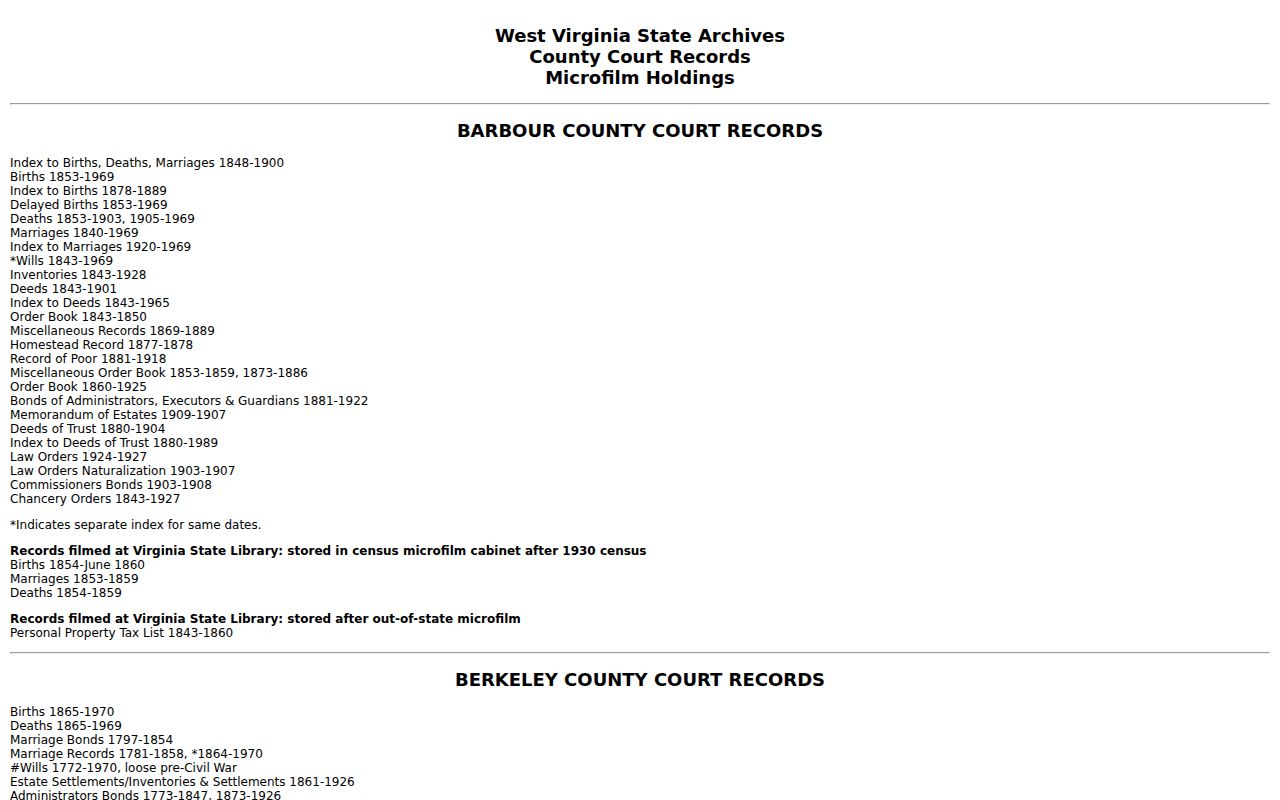
Start with a finding aid to see which county series may exist. Confirm the actual book or microfilm with the clerk or the Archives. Older indexes can trip up a direct name search. Surnames may be alphabetized only by first letter, misspelled, or filed under an officer. Try spouse names and initials too. Estate names and adjacent landowners help when a name query stalls. Deed books and their indexes are permanent. The retention schedule marks them permanent. Land books add annual owner, district, tax, and description clues, and their coverage and archival locations are not uniform.
Getting a West Virginia Deed Copy
Open the county portal as a guest. Check whether a result links to a readable document. Some results require subscriber access instead. For an older or missing image, contact the clerk in the county where the land lies. Give the clerk the parcel number, the parties, a legal description, and any known book, page, or instrument number. Ask the price of plain and certified copies. No single statewide county copy price is stated, and each county's current schedule controls.
The county clerk directory supplies the office route. The clerk can explain counter and mail procedures. Staff may search both grantor and grantee indexes and explain how to pay for copies. State Archives copies and research requests follow separate published fees; the Archives services page lists copy options and written research request limits, so read it before sending a request.
A public-record request under the West Virginia FOIA can reach an index entry, book page, or copy that is not online. Identify the custodian, county, and record group. Add the parties, date range, and format. Under W. Va. Code §29B-1-3, a response is due within the statutory five-day maximum, excluding weekends and legal holidays. The custodian need not create an index. Nor must the custodian conduct legal research. Actual reproduction cost may be charged, not general search labor.
Recorded is not guaranteed. The index shows what was recorded and the deed image shows that instrument's terms. Neither alone establishes that no unrecorded interest, later court order, or other title issue exists. A title opinion requires a separate professional review.
West Virginia UCC Searches Are Separate
A Uniform Commercial Code filing search checks financing records. It is not a deed index. The Secretary of State's UCC search uses debtor name, secured-party name, or filing number, and its online process is separate. A fixture filing tied to real estate also belongs in the county land record. The UCC result does not replace the deed. Nor does it replace a county-recorded mortgage or release. The West Virginia Secretary of State UCC procedures explain the filing search and available result copies.
This filing system adds context about a debtor or a secured party, but that is where its usefulness stops. It cannot establish the owner of record. The clerk's deed chain stays beyond its reach.
Note: Use the UCC filing number or exact debtor name in the SOS portal, then return to the county clerk for the real-estate instrument.
West Virginia Deed Records Stay Local
West Virginia became a state in 1863. County records stayed within each county, as the State Archives explains. That history still shapes deed access today. Each clerk keeps local books and follows a county-specific online transition, while statewide portals and archive catalogs help locate records without replacing county custody.
There is no single statewide imaging cutover year. West Virginia Code §39A-4-4 allows clerks to receive, index, store, archive, and retrieve electronic documents. Authorized paper filings stay in the same index. The law permits converting older paper records. It does not guarantee that every historic volume has been digitized.
Suppose the latest online entry ends at the county's certified date. Step back to the clerk's older books. Ask the Archives about microfilm too. Holdings are incomplete, the Archives notes, so check a missing image against the clerk's own volume list, later re-recorded index, probate or court file, and related land records. The backward route for prior owners is covered in the West Virginia former owners chain.
West Virginia Court Files and Deeds
Some parcel events start in a courtroom. Foreclosure, partition, quiet-title, judgment, probate-related orders, and lis pendens can reach a deed or release later. They connect the circuit clerk's case to the county clerk's land record. A court docket alone is not the recorded instrument. A clerk index alone may not show how the case ended.
The statewide West Virginia court-record access hub links to public court systems. WVPASS expanded public circuit-document access in March 2025. Records dating back to 1999 are included. Older or restricted material may require the circuit clerk's counter. Note the case number. Then match the order or sale confirmation to the parcel description and the later recorded deed.
The county clerk index, the circuit case file, and the assessor's parcel card answer different parts of one question. Keep their dates and references separate.