
West Virginia Property Tax Records
Three offices hold the pieces of a West Virginia property tax record. The county assessor handles value. Assessed real estate lands in the county land book, along with the assessment fields the assessor maintains. The sheriff issues the tax ticket. Payment status follows the ticket, and parcels that reach state collection appear on the State Auditor's County Collections pages. Ask the question first.
| Record field | What it tells you | Where to check |
|---|---|---|
| Land, building, and total appraisal | The assessor's value components for the parcel and tax year. | WV Property Assessment / local assessor |
| Tax class and exemption entry | The property's recorded tax treatment; an entry does not prove occupancy. | Assessment card and county assessor |
| Ticket, tax year, amount, and status | The bill issued for the tax year and whether the sheriff shows it as paid or due. | County sheriff or tax office |
| District and levy context | The local taxing jurisdictions tied to the parcel and the rates used in the bill. | Sheriff's ticket and county levy records |
| Certificate, sale, or redemption status | A later delinquency step, not by itself a deed or final ownership change. | State Auditor and county clerk |
A value, a bill, and a sale price are different numbers. West Virginia counties generally assess property at 60% of fair market value, subject to the applicable valuation method. Tax class and relief then shape the taxable amount. The levy calculation follows from there. The bill covers one tax year. It is not a market price. For what the value fields mean, and for sale history, the West Virginia property value reference is the better stop.
July 1 Starts West Virginia Assessment
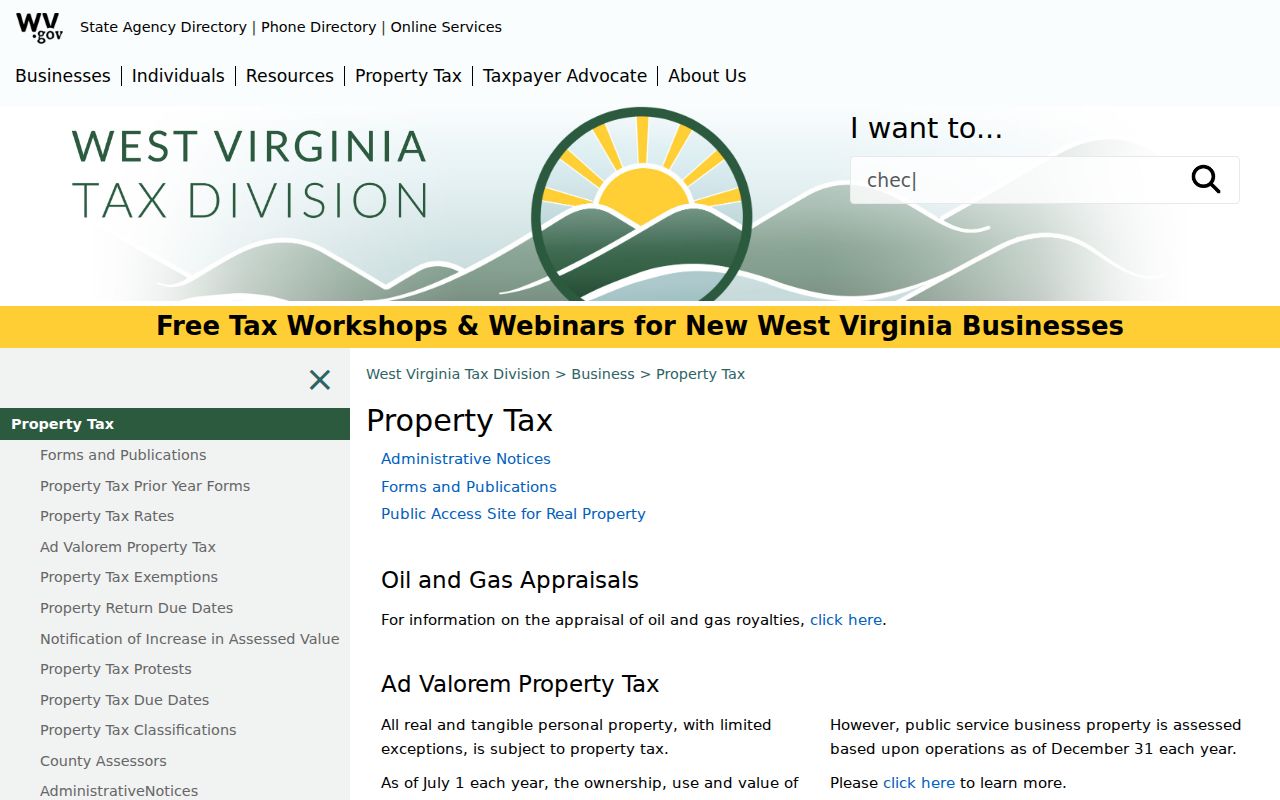
July 1 anchors the West Virginia assessment year. Ownership, use, and value on that date set the next calendar tax year. Public-service business property runs on a different date. County assessors begin their annual work each July 1 and must finish the land and personal-property books by January 30 under W. Va. Code §11-3-2. The state-facing assessment system publishes once a year. So a record can reflect the roll for one tax year rather than a live market change. The Tax Division's property tax page lays out the assessment date and the February review calendar. That official page displays both dates plainly. Comparing years takes care. Check the tax year on the parcel card. Publication alone does not mean every field changed that day, so read the assessment date too.
July 1 is a reference point, not a ceiling. A later sale can support a review of the assessment, but it does not swap in a new value automatically.
Note: Check the local assessor's current notice for forms and filing details because statewide guidance does not supply every county's instructions.
Find a West Virginia Tax Bill
A statewide assessment card can supply the county and parcel number, but no single state portal serves every current county tax ticket. The bill and its payment status sit with the county sheriff or tax office. The WV.gov county directory routes readers to each local office. A sheriff generally issues tickets on or after July 15. Search with the parcel identifier as well as the owner's name, since the Auditor's tax guide warns that a ticket may stay in a prior owner's name when the new deed was recorded late in the cycle.
The State Auditor's property tax payment guide sets September 1 for the first half and March 1 for the second half, with discounts described inside. Confirm the current due date and any discount with the sheriff's notice for that county and tax year.
- Find the parcel in WV Property Assessment and record its county, district, map, parcel, and suffix.
- Contact that county's sheriff or tax office for the ticket, tax year, amount, and payment status.
- Compare the tax class and exemption fields with the assessment card, then ask the assessor about a missing or incorrect entry.
- If the record shows delinquency, search the Auditor's County Collections tools and confirm the next step with the sheriff.
- Assessed value
- The value entered for the tax assessment process; it is not the same as the tax due or a current sale price.
- Market or fair value
- The value the assessor determines under the applicable valuation method before the assessed-value relationship is applied.
- Mill or levy
- The tax-rate and local levy terms used with the parcel's taxable amount; check the current county and district figures.
- Homestead exemption
- A state exemption against part of assessed value for an eligible owner-occupied residence, handled through the county assessor.
- Tax lien
- A claim tied to unpaid property taxes that can move through collection and redemption steps before a deed issues.
Order matters. Assessment lookup first, then the local ticket. The Auditor's delinquency tools come into play only when the account has entered that process, and a statewide parcel result is a locator rather than a substitute for the sheriff's current account.
West Virginia Exemptions and Taxable Value
Tax relief changes the taxable amount. It leaves the recorded assessment alone. West Virginia gives owner-occupied residential property a 50% tax preference under its constitutional and classification framework. The homestead exemption works differently. Under W. Va. Code §11-6B-3, it can exempt the first $20,000 of assessed value on an owner-occupied residence. Age or disability, residency, ownership, and application rules all apply. The county assessor takes the application. County forms and filing instructions control for the tax year at issue. Several programs sound alike but run on different rules. The Homestead Excess Property Tax Credit and the Senior Citizen Tax Credit are not the assessor's homestead exemption. The senior credit requires homestead participation, paid property tax, and income below the stated threshold. The excess-property credit uses a separate test. It applies when tax tops 4% of income. Disabled-veteran relief has its own form. It does not combine the same way. The West Virginia Tax Division and the local assessor hold current eligibility and application steps. An online exemption or class field shows how the parcel was treated in a tax record. It is not proof the owner lives there. Never infer eligibility from the field, and never use a value record in place of the current application review.
Three West Virginia Tax Record Custodians
One parcel can sit in several tax systems at once. The assessor keeps the land book and the appraisal entry. The sheriff writes the tax ticket, takes payment, and runs county delinquency steps. Certified-to-state parcels move into the State Auditor's County Collections workflow. That office also handles Deputy Land Commissioner searches. A clerk, in turn, records instruments like a tax-sale deed once the process runs its course.
The State Auditor County Collections search does not replace a county tax bill page. Its two property-oriented forms carry their own fields. The live page also posts land-sale registration, notice, and deadline details that shift over time. Check it when a search matters.
| Auditor search | Fields documented in the portal | How to use it |
|---|---|---|
| Certified to State | Tax Year and County are required selects; District; Map; Parcel; Sub Parcel; Certificate Number; Taxpayer Name; Purchaser Name; Bidder ID; Description; Ticket Number; Account Number; Status. | One field can start a search; add county and parcel details to narrow a match. |
| Deputy Land Commissioner | County; Certificate Number; Name; Description; District; Municipality; Map; Parcel; Deed Book; Page Number; Account Number; Status; Page Size. | Use the certificate, name, parcel, or book and page shown in the notice or earlier result. |
A tax record is not always online. The Tax Division's county assessor roster points to the right office. Ask what the county offers. Does it have a public terminal, a current ticket search, a copy request form, or an in-person review? Naming a parcel number and tax year helps the staff answer quickly.
Some records are absent online. Request those from their custodian, whether a land-book entry, a tax ticket, or a delinquency notice. West Virginia FOIA opens public records to inspection and copying unless an exemption applies. The public body must respond as soon as practicable. It must do so no later than five days, excluding weekends and legal holidays. An electronic copy is available when the record exists electronically. That format must be requested. The office need not build a new statewide parcel report. The access and copy rules sit in W. Va. Code §29B-1-3.
Appeal a West Virginia Assessment
The Board of Equalization and Review is the first ordinary appeal channel. The county commission sits as that board. It begins meeting on February 1 each year. It may adjourn after February 15 once its work is done. It must adjourn by February 28. Raise a value protest before that year's property taxes come due. Schedules and filing steps vary. Contact the county assessor and commission directly rather than relying on a statewide calendar.
Bring the parcel identifier and the assessment entry under review. The owner can point to the land, building, use, or other field that looks wrong. The owner can ask how the local appraisal supports it. A classification or taxability dispute is not the same as a claim that the value is too high. For that route, W. Va. Code §11-3-24a describes a Tax Commissioner ruling through the assessor. The state also publishes a Petition for Review of Property Appraisal. Confirm the current form and filing address locally.
February review window. The board starts February 1 and may close after February 15, with a final adjournment no later than February 28. Contact the assessor promptly for the current county schedule and protest method.
Note: A value protest and a classification or taxability question use different routes, even when they concern the same parcel.
West Virginia Tax Sale Statuses
Delinquency is a sequence, not one event. A sheriff's ticket may show an unpaid balance. A later delinquent-land notice can lead to certification, sale, redemption, and finally a deed. The live page for sale results offers buyers one warning. Confirm dates, places, and payment terms with the sheriff. The Auditor's County Collections FAQ describes an 18-month redemption period in its workflow. Later legal changes and current instructions belong to the live county and Auditor pages.
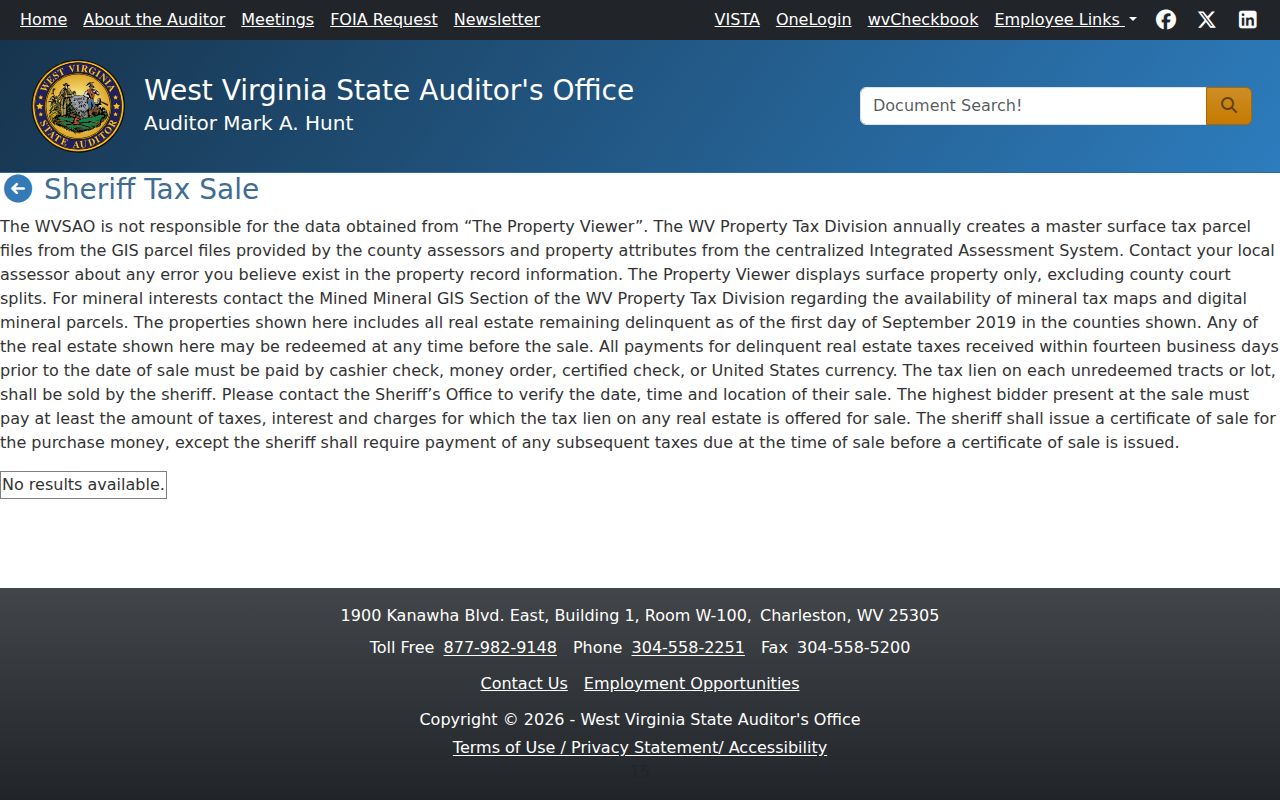
The Sheriff Tax Sale Results page displays current results as the Auditor publishes them. An empty panel does not prove a parcel is clear. Unpaid tax, prior notice, or a separate county record may still exist. Search the parcel's status and year first. Then ask the sheriff or Auditor to explain the stage before acting.
The Auditor FAQ also corrects a common misreading of "certified to state" or "sold to the state." In the described workflow, the state holds a tax lien during the redemption period; the phrase alone does not mean the state owns the land or minerals. Surface parcel files can leave out county court splits. Mineral interests follow a separate mapping path.
Note: Current sale listings and deadlines are live data, so verify them with the sheriff and Auditor instead of relying on an older capture.
Tax Sale and Foreclosure Are Different
A tax sale enforces a public tax lien. Foreclosure follows a lender or secured creditor through a court case or other legal process. One parcel can carry both histories. So a tax result reveals nothing about mortgage priority, releases, court rulings, or final title. The county clerk holds recorded lis pendens, sheriff or commissioner deeds, and similar instruments. The circuit clerk's file supplies the complaint, judgment, sale confirmation, and related orders.
For a foreclosure or quiet-title question, use the Judiciary's WVPASS court-record access hub and the county circuit clerk. Public circuit documents date to 1999, per the statewide launch notice. Older or restricted files remain a clerk question. Compare the case number and dates against the recorded instrument. Never read a tax-sale certificate as a deed. The real checkpoint is a recorded tax-sale deed in the county clerk's land-record index.
West Virginia Ratio Studies for Tax Reading
The Tax Division's annual ratio study is a way to read statewide assessment patterns, not to set a single parcel's sale price. The 2025 study uses sales verified by assessors from July 1, 2023 through June 30, 2024, and reports Tax Year 2025 values as of July 1, 2024. Its tables cover residential, apartment, commercial, industrial, and combined property. Aggregate and median ratios, along with dispersion, describe groups of sales rather than the value of an individual home or tract.
The state property-assessment data also labels sale date, price, sale type, source, and validity. Those labels matter because a multi-parcel transfer, related-party sale, foreclosure, abnormal financing, construction-only transaction, or conveyance with personal property may not be a normal market comparison. The Tax Division's assessment ratio studies and publications explain the annual data. For a specific tax bill, return to the sheriff's account; for an individual value field, inspect the parcel record and its year.