
West Virginia Former Owners by Record Era
Each former owner is traced one transfer at a time. Treat the table as a chain log. Fill every row from the deed or book entry for the parcel you are studying. Do not use a sample transaction. No statewide starting year can be entered for the online index. Each county sets its own certified date.
| Transfer date | Grantor to grantee | Deed type | Book/page or instrument |
|---|---|---|---|
| Record the latest deed date | Copy both parties from that instrument | Use the clerk's index label | Copy the full reference |
| Record the prior acquisition date | Search the prior grantor as grantee | Read the next deed label | Keep its own reference |
| Record the older book entry date | Check both name sides and the land description | Copy the deed-book wording | Note volume and page |
| Record the first entry found in a book run | Continue with earlier owner or estate names | Note any officer or fiduciary | Keep the Archives or clerk citation |
A West Virginia chain can leave the county index. Physical deed books, microfilm, or archive finding aids may follow. The right source depends on the parcel's county and the record's year, not on any statewide online cutoff.
Trace West Virginia Former Owners Backward
Start at the newest deed entry. The grantor is the next name to trace. Look for that former owner as a grantee on the prior deed. Estate, court, tax-sale, and other routes can break the pattern and call for another record group.
- Find the latest deed from the current parcel reference. Record the grantor, grantee, recording date, document type, legal description, and book/page or instrument number.
- Search the grantor side for the instrument that brought the same land to that person. Compare lot, block, district, map, acreage, and any plat reference.
- Use that earlier deed's grantor as the next prior owner. Repeat, checking that the land description still matches.
- Search the name with initials, alternate spelling, spouse, estate, and fiduciary forms if the index path breaks.
- At the county's certified online limit, move to physical deed books, clerk indexes, Archives finding aids, and available microfilm or digitized collection records.
- Grantor and grantee
- The names indexed for the parties conveying and receiving an interest.
- Chain of title
- The linked recorded instruments for the same land, followed from one transfer to the next.
- Reverse index path
- Search the latest grantor as a prior grantee, then repeat with that deed's grantor.
- Warranty and quitclaim
- Labels may carry different deed language. Read the recorded instrument; an index label alone does not explain its terms.
Names repeat across a county. Matching names alone prove nothing. Compare the legal description, acreage, lot or tract, book and page, and nearby land references.
Turn to the index early. The broader West Virginia deed records page explains the county clerk index and how to obtain a particular recorded deed, and former-owner work leans on that index repeatedly to rebuild time depth.
West Virginia Former Owners in Officer Deeds
A backward chain can reach an officer's deed. The signer may be a trustee, special commissioner, sheriff, executor, or administrator. West Virginia Code §39-2-2 covers the indexing pattern. Under that rule, a deed made by a trustee, special commissioner, or officer is indexed in the former owner's name as well as the executing person's name. Search both sides. Do not treat the signer as the prior owner.
Estate, foreclosure, partition, tax sale, and court order transfers all fit this pattern. The grantee-to-grantor sequence pauses. The next record may be a will, fiduciary file, court decree, or deed to a purchaser. The county clerk's index locates the land instrument. The circuit or county clerk's file can supply the order or estate record that explains why the owner changed.
Capture the case number. Record the fiduciary name with the deed reference too. Then compare the underlying legal description with the parcel being traced, since a valid index entry can still leave the transfer context in another record set.
West Virginia Deed Books Beyond Online Years
County deed books and indexes extend the search before a portal's certified date. Older volumes live in archives. The Archives county court microfilm finding aid identifies local runs that can include deed books, grantor-grantee indexes, trust deed books, surveyor books, land books, and tax records. Runs vary by county. Some are incomplete. Confirm the volume before relying on any archive listing.
Use the finding aid to pick a county and record series. Then ask the clerk or Archives about access. Ask whether the specific pages survive. An archive listing is a route to a record group, not proof that every book or page is present.
Older indexes have quirks. Some sort surnames only by first letter. Spelling variants appear, and an officer's deed may be filed under the officer. Try initials, spouses, estates, adjacent landowners, and the legal description when an exact modern name query fails. A plat or survey book can explain why an older tract description later became a lot and block.
Note: Deeds and deed books are permanent county record groups, while a missing online image may still require a clerk-vault or Archives search.
Old Land Books Add West Virginia Owner Clues
Land books fill the gap between deed entries. The Archives' collection summary gives statewide archival scope from county formation through the 1930s. Nearly half of counties extend through 1959. Coverage varies by county. Check the local assessor, the county clerk, and the Archives inventory for the county and district at issue.
A land book pins a name to a year. It lists the district, parcel description, and assessment. It can hint when an owner label or parcel description changed. Still, it is not a deed. It cannot prove a transfer alone. Compare each name and description against the grantor-grantee index and the recorded instrument.
West Virginia retention rules mark deeds and deed books permanent. Land books may be kept ten years once an assessor copy transfers, while historic archival copies and other record groups can run longer. The storage path varies. A record may sit with the assessor, the county clerk, State Archives microfilm, or an archive catalog, depending on the county and series. The Archives services page lists current access and copy guidance.
Note: Retention rules point to a likely custodian, but the county and record series decide whether a particular year survives.
Old Addresses Can Hide Former Owners
Street names and rural addressing change. The legal description stays the better key to the land. A deed may cite acreage, a parent tract, lot and block, a stream, a road, or a survey call. It may also cite an older plat rather than a modern E-911 address. So search a former owner through the instrument description and book reference. Do not rely on a present-day street string alone.
For a subdivision, the clerk's plat or survey book is the place to compare details. Check lot, block, section, phase, plat book and page, and approval date against the assessor description. A split or combined tract can carry a new parcel number. An older deed may still point to the parent parcel. The map helps orient the search. The recorded plat and deed description supply the land record.
Address history adds context. An old deed may give a name but no current street. The State Archives holds city directories and newspapers with uneven year runs. A directory can place an occupant at an address. It can also show a street before modern numbering. It does not prove ownership. It cannot replace a deed.
West Virginia Directories for Property History
Old city directories are a good starting point for tracing property history. The Archives directory listings reach back to Wheeling in 1851 and Charleston in 1874-75, with longer runs for many other cities in later decades. Coverage varies from town to town. First and last years differ, and gaps are common, so confirm the listing you need before comparing addresses across years.
The West Virginia State Archives city-directory holdings page describes the towns and year runs available for address research.
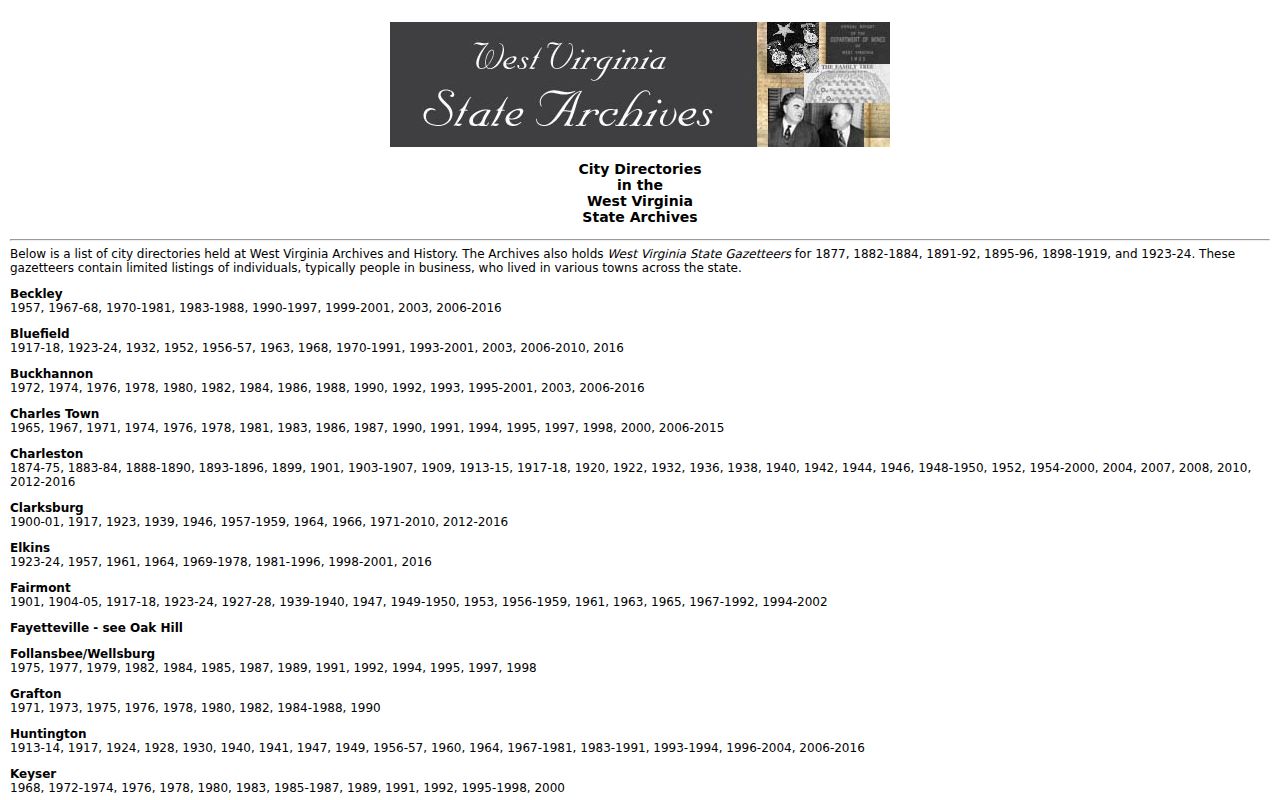
Directories are contemporaneous address and occupant sources. They are not title sources. Use them to test whether an address clue fits the period around a deed. Then return to the county book or instrument for ownership evidence.
The holdings page lists year ranges only. It shows no sample household entry. Inspecting a specific name and address takes a local volume, so for a visit or written request, check the Archives' current services and copying guidance before assuming a volume sits on open shelves.
Note: Directory year runs vary by city, so rely only on the years listed for the specific collection rather than assuming a continuous series.
West Virginia Archives Memory Search
The State Archives' WV Memory database searches digitized collections. It is not a statewide deed index. Search controls cover words anywhere, collection, topic, geography, people, and records per page. A result can tie an old parcel name or owner to a photo, map, paper, or archival item. It still cannot replace the county clerk's deed book.
The WV Memory collections search can help find archive material related to West Virginia land and community history.
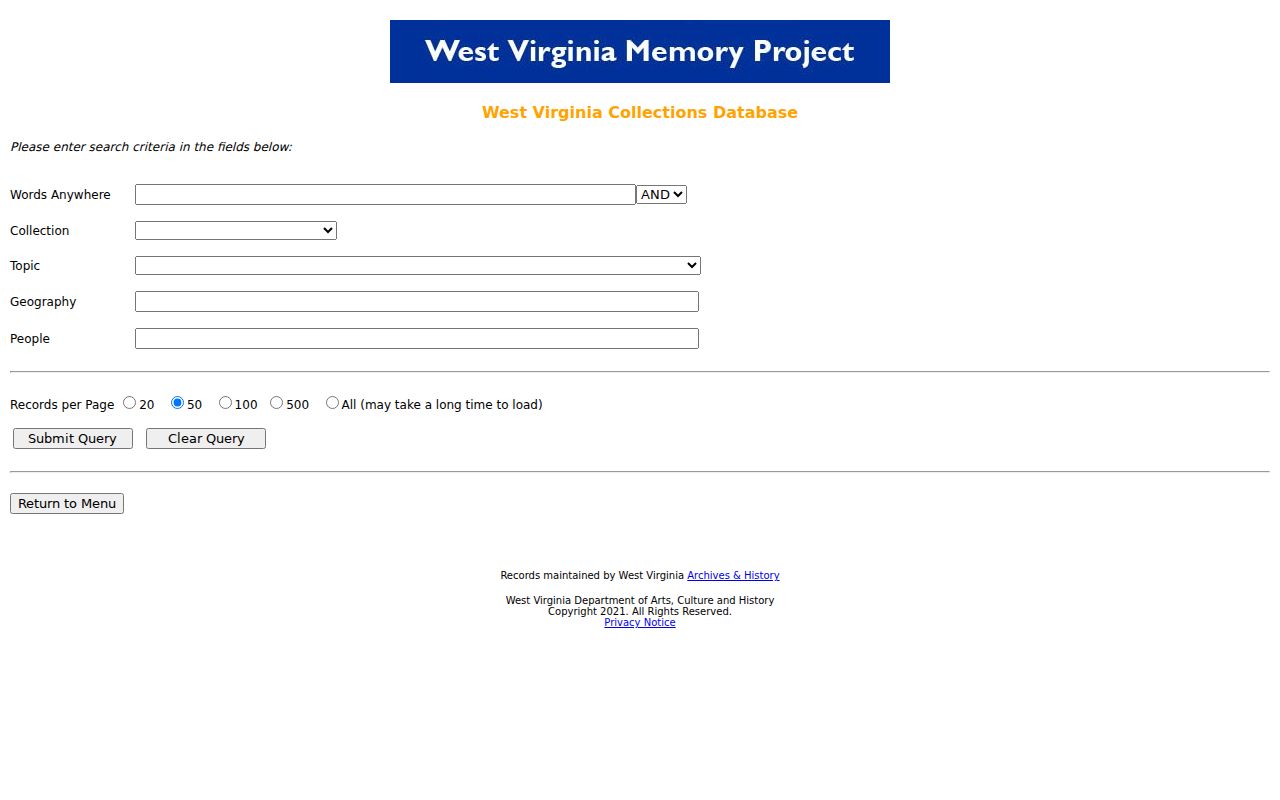
Record the collection title, county, and date range. Note whether an image or an account exists. A broad result is a lead. Verify the land and the parties against a primary instrument or another county record.
Selected land and other county records may also appear in Archives or partner catalogs, and a digitized collection is never a complete run for one county.
West Virginia Ownership Records Across Time
West Virginia split from Virginia and became a state in 1863. County land records stayed in local custody. Deed books simply continue county by county. The Archives' historical record groups do not form one complete statewide online chain. The State Archives treats deed books as permanent and offers county-specific finding aids, though its microfilm holdings stay incomplete.
When a chain has a gap, check several places. Look at the clerk's missing-volume note, later re-recorded index, land books, probate or circuit-court records, plats, newspapers, and neighboring deeds. A break can come from a missing book, a partial conveyance, an unrecorded family transfer, or an index variation. Do not assign one statewide ending year to former owners. Use the county's certified date for its portal. Then work through the local book and archive evidence.
There is no statewide online cutoff. Check the county's certified date, then ask the clerk or Archives about earlier deed books and microfilm. Use former-owner records for lawful property history and due diligence, and do not use them to track or harass a living person.
A chain of title that continues past the portal stays easy to follow when each document keeps its own paper trail. Record the date, county, book, page, and collection reference beside the land description for every deed you pull. That way the next former-owner search starts from a recorded document rather than a guessed street address, and the property records line up cleanly from owner to owner.