
West Virginia Property Value Types
Several numbers can sit beside one parcel. Yet each comes from a different record and date. Fair market value is the assessor's supported estimate for the statutory assessment process. Assessed value is not the same thing. West Virginia's assessment method produces it. Recorded consideration is the price in the sales history or deed trail. It reflects a past transfer. A sample card may also split land and building values before showing a total. Read the date and field label first.
| Value type | What it means | Where it is recorded |
|---|---|---|
| Fair or market value | The assessor's estimate used in the statutory valuation process. | Assessment card and state assessment framework. |
| Assessed value | The value set under the applicable assessment relationship or legislative method. | County land book and assessment card. |
| Recorded sale price | Consideration reported for a prior transfer; not automatically today's market value. | Assessment sales history and county deed record. |
| Land, building, total | Components shown on the individual assessment card; fields vary by parcel. | WV Real Estate Assessment Data card. |
The assessed value and the last price need not match. West Virginia generally sets assessed value at 60% of fair market value. Sometimes a legislative valuation method sets the number instead. Tax class and exemptions then shape the taxable result. A price can cover multiple parcels. It may include personal property, a related party, or unusual financing. For the ticket, exemptions, and appeal process, see West Virginia property tax records; the value comparison itself stops at what each number represents and where it appears.
West Virginia's 60 Percent Assessment Rule
County-assessed property in West Virginia is generally valued at 60% of fair market value, according to the Tax Division. A legislative valuation method sometimes sets the figure instead. The assessor's estimate anchors the assessment system. It is not a quote for a sale. Tax class and exemptions enter the calculation later. Keep three figures in separate columns: the full-value estimate, the assessed value, and the taxable amount.
The state also describes owner-occupied residential real property as receiving a 50% tax preference under the constitutional and classification framework. That preference is not the homestead exemption. It is not a cash credit either. The West Virginia Property Tax Division explains the valuation relationship and the tax-class framework. An online class field can help explain a difference in the taxable result. It cannot prove every fact about how a property is used.
West Virginia's Value Snapshot Date
For most county-valued property, ownership, use, and value are set as of July 1 for the next calendar tax year. Public-service business property follows a separate date. County assessors begin their yearly assessment work on July 1 and must complete the land and personal-property books by January 30 under W. Va. Code §11-3-2. That cycle creates a dated snapshot. It is not a daily estimate of changes in the local market.
The statewide viewer publishes assessment information annually when the new tax assessment is released. A parcel card may therefore show a tax-year value that predates a more recent sale or improvement. The Tax Division's forms and publications page carries annual ratio studies and valuation material. Check the tax year printed on the card before comparing its value to a later event.
Note: The assessment date controls the value snapshot, while a record's publication date only tells you when the page or file appeared.
Read West Virginia Land and Building Fields
A WV Real Estate Assessment Data card brings information together. Owner and mailing address sit apart from the physical address. The rest lists property location, parcel ID, legal description, building information, cost values, appraisal values, sales history, and parcel history. Building details cover year built, heat, air conditioning, bedrooms, baths, and total rooms. Flood information can show acres and risk. Exact subfields depend on the parcel. The group names matter. Land value, building value, total appraisal, and recorded sale are different measures.
| Card area | Fields shown in the sample | How to read it |
|---|---|---|
| Property location | Physical address, E-911 address, county, district, map, parcel, and suffix. | Use these to match the assessment to the mapped parcel. |
| Appraisal | Cost value, land appraisal, building appraisal, and total appraisal headings. | Read the displayed year and the field labels; detail can vary. |
| Sales history | Sale date, price, type, source code, validity code, book, and page. | A transfer record requires context before it is used as a comparison. |
| Parcel history | Tax year, tax class, owner, owner address, book/page, legal description, land, building, and total. | Compare year by year without treating a mailing field as situs. |
The linked sample West Virginia assessment detail is the source for the card shown here. Its history keeps sales and assessment rows separate. The gap between a prior transaction and a later appraisal is easy to see.
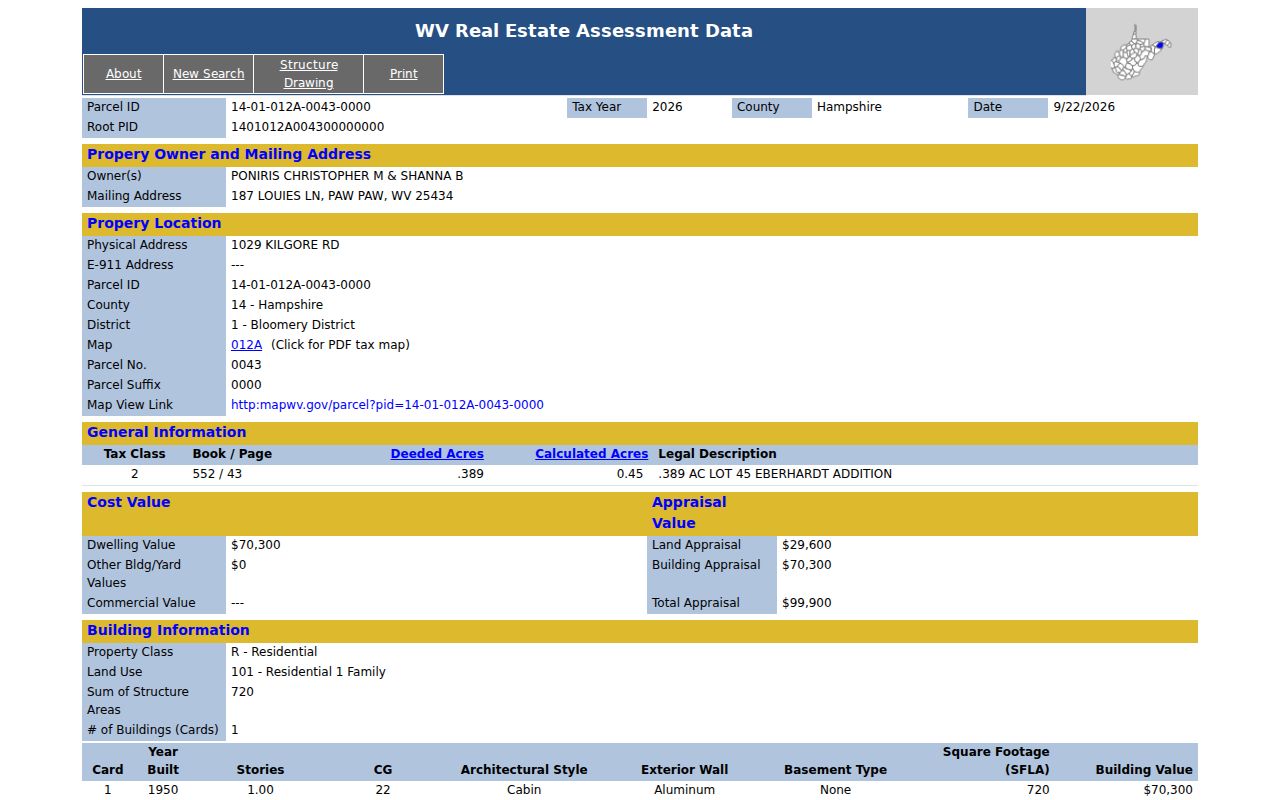
The card is an example of fields. It is not a forecast for a current sale. Use the county clerk's deed to verify the instrument behind any transfer, and the card to see what the assessor recorded.
Recorded Sale Price Has Its Own Context
Last sale price is a transaction clue. It is not a live estimate of market value. The assessment system shows sale date and price beside sale type, source, and validity codes. The state's sales-description guide distinguishes land, land and buildings, and a building on leased land. A source may be a buyer, seller, agent, or conveyance-fee source. The validity label flags non-market transfers.
| Sale field | What it records | Why it changes the comparison |
|---|---|---|
| Sale type | Land; land and buildings; or building on leased land. | The price may cover a different bundle of property interests. |
| Source code | Buyer, seller, agent, or another conveyance-fee source. | Shows where the sale data came from, not its market quality. |
| Validity code | A reason the transfer may not be a normal arms-length indicator. | May flag multiple parcels, changed highest and best use, related parties, foreclosure, abnormal financing, or personal property. |
Changed highest and best use and construction-only transactions carry their own state flags. Such prices may not fit a normal comparison. Extra parcels or personal property skew it. When the consideration matters, open the deed or transfer record and read the assessor's source and validity labels before concluding anything.
West Virginia Property Ratio Study Measures Groups
The 2025 Assessment Ratio Study uses sales verified by county assessors from July 1, 2023 through June 30, 2024, and reports Tax Year 2025 values as of July 1, 2024. Its tables cover residential, apartment, commercial, industrial, and combined classes. Aggregate and median ratios and dispersion describe how groups of sales compare with assessments. They are statewide or class-level measures, not a single parcel's market appraisal.
The 2025 West Virginia assessment ratio study can help explain how the state reviews assessment patterns. It cannot tell a reader what an individual parcel would sell for today. For one property, start with the assessment card and its value year, then separate the assessor's estimate from its recorded sale history.
Tax Class Changes West Virginia Taxable Value
Assessed value and taxable amount are not always the same figure. The public card may show a class or exemption entry. That field still does not prove who lives on the property. A tax class, preference, or exemption can shrink the second number. It does so after the first is set. West Virginia runs several distinct relief programs. These include the homestead exemption, senior and excess-property credits, and disabled-veteran relief. Each has its own conditions. The assessor administers the homestead exemption; state publications spell out the others.
Check whether the record shows the assessed figure before relief. It may instead show the taxable amount after it. Never add a preference and an exemption as though they were one discount. The state Tax Division's current program information and the county assessor can explain any entry. Paying bills, filing applications, and protesting an assessment sit in a separate property-tax process.
Tax Sale Status Is Not Market Evidence
A delinquent-land or tax-sale field tracks collection status. It is not an open-market price. The State Auditor's FAQ explains the point. "Certified to state" or "sold to the state" means the state holds a tax lien while redemption runs, not that the state owns the land or minerals. A tax certificate, an auction notice, and a recorded deed are three different stages.
So keep distressed listings out of any market comparison. Unpaid tax, a redemption period, or a later deed may complicate the transaction. That deed belongs in the county clerk record. The State Auditor's County Collections portal posts live status and deadlines. Those details shift often, so confirm them at the moment you read.
Look Up the West Virginia Assessed Value
Start in the statewide assessment system to find the value of record. It covers all 55 counties. County assessors handle the local corrections. Open the parcel detail rather than stopping at a result row, since the card can hold assessment values, sales history, parcel history, and a link to a report or PDF map. The steps that follow keep the assessment value and the recorded sale on separate tracks.
- Open WV Property Assessment and choose the county and the address, owner, or parcel mode that matches the information in hand.
- Open the parcel card and note the tax year, land and building entries, total appraisal, tax class, and legal description.
- Read the sales-history date, price, type, source, and validity fields as a separate record of past transfers.
- When the reported consideration matters, confirm the instrument and book/page through the county clerk's deed index.
- Assessed value
- The amount set under West Virginia's assessment relationship or applicable legislative method.
- Fair market value
- The assessor's supported estimate used as the basis for the statutory valuation process.
- Appraisal field
- A land, building, or total value shown on the assessment card; it is not a private appraisal opinion.
- Assessment ratio
- The relationship between assessed value and the value used by the assessment method; county property is generally assessed at 60%.
- Sale or consideration price
- The amount reported for a past transfer, which may include more than one parcel or other property.
- Reassessment cycle
- The annual tax-year process that sets ownership, use, and value as of the assessment date.
An assessor card is a public valuation record, nothing more. It is not a custom appraisal. When a value entry looks wrong, call the county assessor through the statewide assessor roster. Ask how it was set. Any formal value protest goes through the Board of Equalization and Review process. It is laid out in the property-tax rules.
What West Virginia Property Value Cannot Say
An assessment is a value built for the public tax system. It is not a licensed appraisal for a purchase, refinance, estate, or private sale. It reflects an earlier tax-year snapshot and a mass-appraisal method. A sale, by contrast, depends on the property, the buyer, the seller, the terms, and the timing. A recorded price is itself only a past transaction. It may be an unusual transfer, a multi-parcel conveyance, or a sale bundled with personal property. It is not a clean measure of one parcel's current market value.
The assessment card shows what the county recorded for the tax year. A licensed appraiser supplies a current opinion of market value when a transaction requires one. The value field is not a listing estimate. It is not a guarantee of sale proceeds or proof of a property's condition.
Assessment is not an appraisal. West Virginia's assessed value is part of the tax process, not what a property will sell for. It does not predict a current market sale or replace a licensed appraisal.
Note: The assessed amount, taxable result, recorded consideration, and current market opinion answer four different questions.